

Vintage Shiny Brite ornaments are identified by the way several details agree with one another: the box, cap or hanger, glass, finish, condition, and any known history of the set. A marked box or cap is a helpful start, especially when the rest of the ornament tells the same story.
Shiny Brite ornaments have a special place in American Christmas collecting. They belong to the era when American-made glass ornaments became a familiar part of holiday trees, especially during the 1930s, 1940s, and 1950s. Their appeal is easy to understand: bright color, recognizable packaging, nostalgia for midcentury Christmases, and enough variation to reward careful looking.
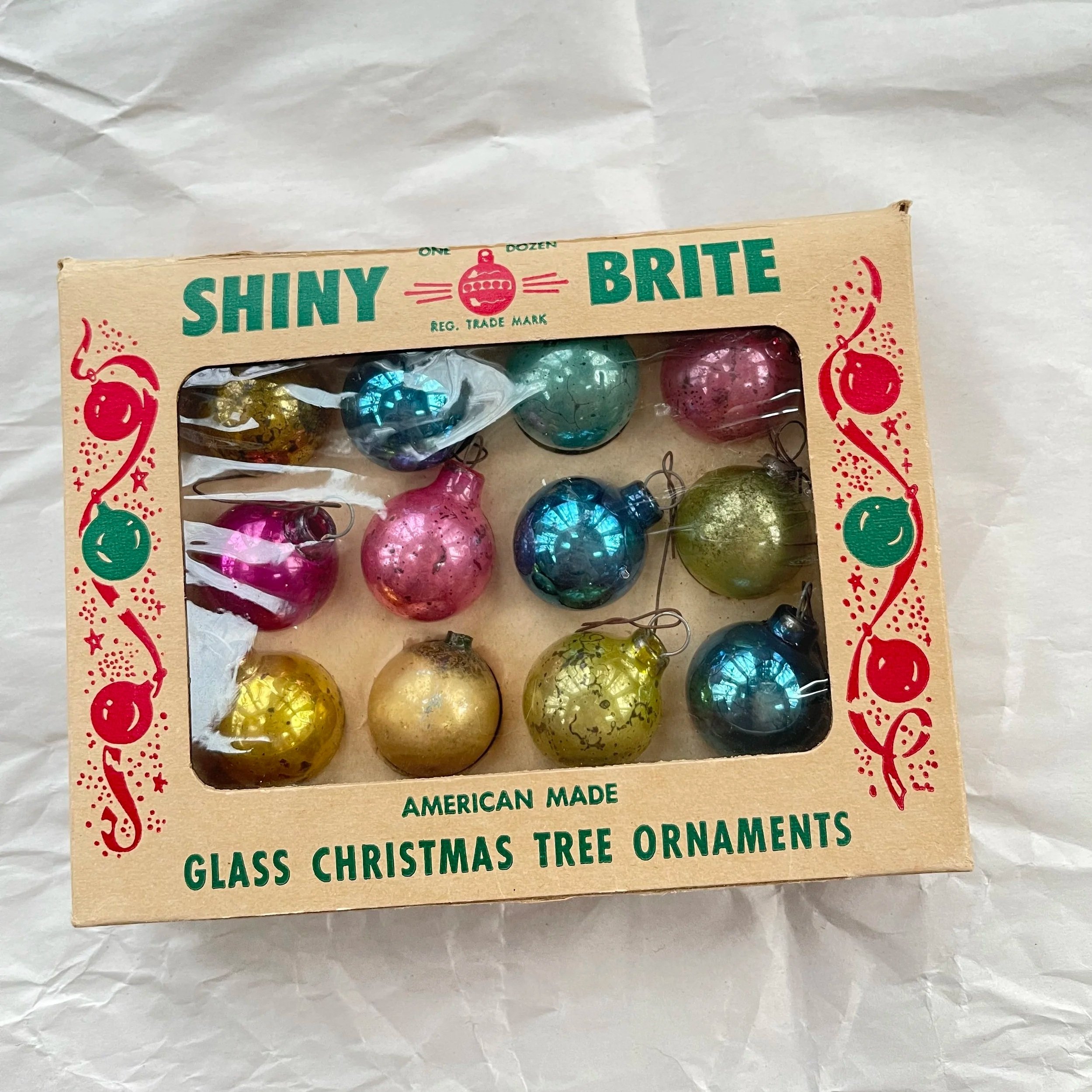
Original Shiny Brite box with American-made glass Christmas tree ornaments.
The history of Shiny Brite ornaments
Shiny Brite was an American Christmas ornament brand associated with Max Eckardt and Max Eckardt & Sons. The Corning Museum of Glass dates the Shiny Brite Company to 1937 and describes museum examples as machine-made, enameled, and silvered glass connected with Corning Glass Works.
That timing matters. European imports dominated the U.S. ornament market during the 1920s, while Lauscha, Germany, was an important center of glass ornament production. The Henry Ford reports that European imports accounted for 99 percent of the 50 to 80 million ornaments sold annually in the United States during that period. As European imports became less secure, American companies had a practical reason to make glass Christmas ornaments at scale.
Corning Glass Works brought manufacturing capacity to the story. At its Wellsboro, Pennsylvania plant, Corning adapted ribbon-machine production, originally associated with light bulbs, to make machine-produced glass ornament bulbs. In 1940, Corning produced 40 million clear ornament bulbs. The Henry Ford reports that about one-third were decorated by Corning, while the rest went to outside decorating companies. Eckardt's New Jersey decorating operations were part of that wider production chain.
World War II changed some Shiny Brite ornaments in visible ways. The Henry Ford documents an unsilvered Shiny Brite ornament dated 1942 to 1945 that retained a thin metal cap. It separately documents 1943 to 1945 examples with folded cardboard hangers and with cardboard, string, and glue. A documented 1946 to 1955 example shows the return of silver lacquer and metal caps. These museum examples are useful for collectors, especially when the hanger, finish, box, and set history all point in the same direction.
How to identify vintage Shiny Brite ornaments
Begin with the easiest things to read, then move closer. The broader process for identifying vintage Christmas ornaments applies here too: compare several details instead of relying on one mark.
Useful places to inspect include:
• Printed box wording, including brand, trademark wording, country wording, count, and ornament description.
• Cap marking, cap construction, cap fit, and wear around the neck.
• Ornament neck shape, chips, cracks, or repairs.
• Interior silvering or an unsilvered interior.
• Exterior finish, paint, and visible decoration.
• Consistency among the ornaments inside a boxed set.
• Family history, estate notes, purchase records, or other provenance.
Wear helps describe condition, but wear alone is not authentication. A scratched or faded ornament may be old, poorly stored, repaired, or simply handled often. The stronger question is whether the visible age, materials, construction, and packaging make sense together.
Check the box and printed labels
Shiny Brite boxes can be some of the clearest identification material. The boxed set photographed for this guide shows readable printed wording, including "SHINY BRITE," "REG. TRADE MARK," "AMERICAN MADE," "GLASS CHRISTMAS TREE ORNAMENTS," and "ONE DOZEN."
Boxes also create one of the biggest attribution traps. Many old Christmas boxes were reused for decades because they were sturdy and familiar. Ornaments break, replacements get tucked into empty spaces, and estate lots are rearranged. A branded box adds useful context, especially when the ornaments match in size, wear, and style. A mixed box still needs a careful description.
Inspect caps and wartime hangers
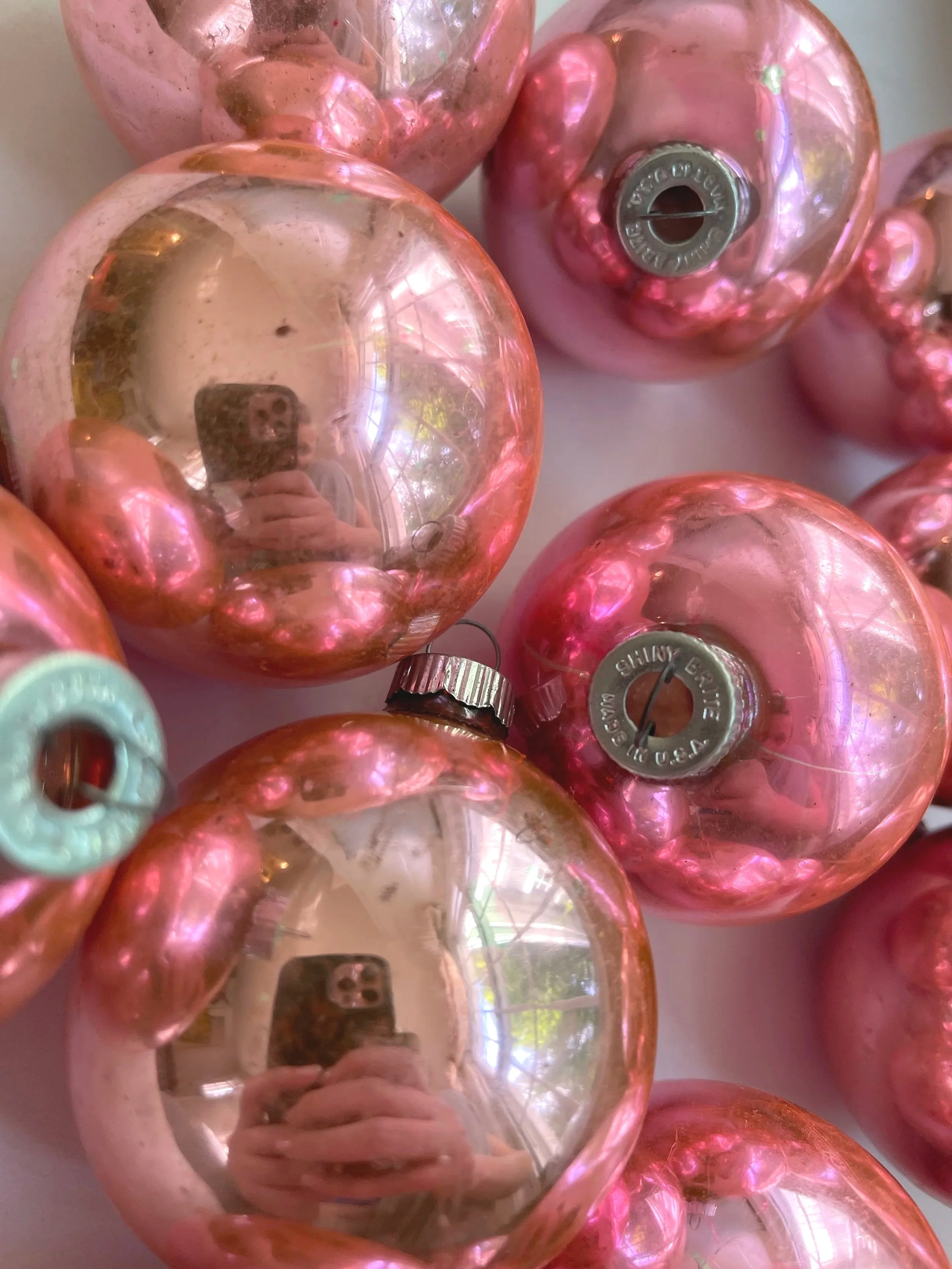
A marked cap can contribute a great deal when its construction and fit make sense with the ornament and the condition around its neck. Read the wording, then study how the cap sits on the neck. A cap that looks too new, too loose, or mismatched to the surrounding wear deserves a note.
Caps are also easy to change. A damaged ornament can receive a replacement cap, and a loose cap can move from one ornament to another. That is why cap wording works best alongside glass construction, finish, box details, and provenance.
Wartime Shiny Brite examples require especially careful reading. The Henry Ford examples show how material shortages could affect silvering, metal caps, cardboard hangers, string, and glue during different wartime years. Avoid dating a piece from one material alone. The most persuasive examples are the ones where hanger, finish, box, and known history point to the same period.
Compare glass shapes, silvering, and finishes
The strongest sources describe Shiny Brite as machine-made glass, with silvered and enameled examples connected to Corning Glass Works and Max Eckardt & Sons. The wartime examples described by The Henry Ford include unsilvered ornaments. The boxed set photographed for this guide shows small round ornaments, while the Corning Museum of Glass includes bell-shaped Shiny Brite examples in its collection notes.
If the ornament has a recessed center, the guide to identifying vintage indent Christmas ornaments explains which construction and condition details are worth comparing.
The vintage glass ornament guide explains how construction, silvering, caps, and finishes work together when you are deciding whether Shiny Brite is the right attribution.
What collectors look for in Shiny Brite ornaments
Collectors often look beyond the brand name to the combination of form, decoration, condition, packaging, and set completeness. Round balls are the most familiar, but the Corning Museum of Glass also documents bell-shaped Shiny Brite examples. Original boxes, legible labels, cohesive sets, strong surviving color, and clearly documented wartime construction can all add context and appeal.
Stenciled designs, stripes, unusual color combinations, smaller sizes, and cohesive boxed assortments may draw more attention than ordinary loose balls, but no single feature guarantees rarity or value. Compare recent sold examples with similar size, decoration, condition, packaging, and completeness rather than relying on broad price lists.
Small Shiny Brite balls are also sometimes gathered into cluster-style arrangements for a fuller display. Unless original packaging or provenance supports the grouping, treat a cluster as a display arrangement rather than proof that the ornaments were originally sold together. Use extra care with the combined weight, and avoid placing that weight on fragile cardboard hangers.
Current Shiny Brite and other American-made glass ornaments appear in the shop as inventory changes.
Condition and collectibility
Condition affects both collecting interest and value. Start with structural damage: cracks, chips, neck damage, repairs, and unstable caps. Neck damage matters because the cap and hanger put stress on that part of the ornament.
Next, look at the finish. Interior silvering loss, exterior paint wear, spotting, scratches, and flaking should be described plainly. These details may be expected on older ornaments, but they still affect display, value, and preservation. If paint is flaking or a finish feels unstable, follow the guide to caring for vintage Christmas ornaments before cleaning or packing the piece away.
Caps and hangers deserve their own note. A replaced cap, missing hanger, bent cap, or fragile cardboard hanger can change how a collector describes the ornament. The box matters too. A complete, well-documented set in branded packaging has more context than loose ornaments with no history, especially when the pieces look consistent with one another.
Documentation adds another layer. Family provenance, old storage notes, original packaging, purchase records, and clear photos of the cap, box, and ornament all make future identification easier. When researching what a vintage ornament may be worth, compare recent sold examples rather than active asking prices. A branded box adds interest and context, but rarity and value still depend on the ornaments, condition, completeness, documentation, and comparable sales.
Vintage Shiny Brite and later revival ornaments
Shiny Brite also appears in modern shopping contexts, so collectors should separate vintage ornaments from later revival pieces and vintage-style decorations. Start with the packaging, markings, and retail presentation. A familiar brand name or nostalgic packaging style cannot establish midcentury age on its own.
Then compare the cap construction, finish, packaging, and retail presentation with documented vintage examples. Provenance also matters. Family records, original purchase information, and clear collection notes can help place an ornament in context. Condition alone cannot establish age.
Later revival ornaments can be attractive and collectible in their own category. They should be described as vintage only when their age is supported.
If you are new to the category, start with this introduction to vintage Christmas ornaments before comparing Shiny Brite-specific details.
A practical examination guide
1. Read the box and labels. Note the brand name, trademark wording, country language, count, and ornament description.
2. Photograph the cap or hanger. Capture the wording, construction, and how it sits on the ornament neck.
3. Examine the neck and glass construction. Record chips, cracks, repairs, and whether the cap fit looks consistent with the surrounding wear.
4. Study the silvering and exterior finish. Describe silvering loss, unsilvered glass, paint wear, fading, spotting, or flaking without turning wear into proof of age.
5. Compare the ornaments within the set. Notice whether size, finish, form, and condition feel consistent or mixed.
6. Record repairs, replacements, provenance, and uncertainty. A careful note now helps the next review, sale, storage plan, or family handoff.
Frequently asked questions
How can you identify a vintage Shiny Brite ornament?
Read the box, cap or hanger, glass, finish, condition, and provenance together. A marked box or cap is useful when the ornament’s construction, packaging, and known history are consistent with it. Be cautious with any piece that relies on a single detail for identification.
Are ornaments in a Shiny Brite box always original to the set?
No. Old boxes were often reused, refilled, or rearranged as ornaments broke or collections changed. A boxed set is stronger when the ornaments match in size, finish, wear, and family or purchase history.
Where were Shiny Brite ornaments made?
Museum sources connect Shiny Brite with American production, Max Eckardt, and Corning Glass Works. Corning produced machine-made glass bulbs, while decorating and packaging involved outside operations, including Eckardt's New Jersey decorating plants.
What are the wartime clues on Shiny Brite ornaments?
The Henry Ford documents a 1942 to 1945 unsilvered Shiny Brite ornament with a thin metal cap, 1943 to 1945 examples with cardboard hangers and cardboard, string, and glue, and a 1946 to 1955 example with silver lacquer and metal caps. Read wartime details alongside the full ornament, box, finish, and provenance.
How can you distinguish vintage Shiny Brite ornaments from later revival pieces?
Study the packaging, markings, cap construction, finish, retail presentation, and provenance. Newer revival pieces can use nostalgic colors or branding, so age should come from more than the name. Describe later pieces clearly when their age points to a revival or vintage-style category.
Shiny Brite ornaments reward careful observation. Photograph the box, cap, neck, and full ornament before packing the set away, then keep the photos, condition notes, replacements, and family history together in the Tinsel Box ornament inventory app.