

Some antique German ornaments do not shine with the smooth reflection we expect from a silvered glass ball. Instead, their surfaces look frosted, granular, and almost sugared. Tiny pieces of ground glass catch the light across a pear, grape cluster, pinecone, or other blown form, giving the ornament a texture that is both delicate and surprisingly vivid.
Collectors commonly call these crushed glass ornaments, sugar-coated ornaments, or sugar-glitter ornaments. The names describe the decoration applied to the exterior, not the material from which the ornament itself was formed.
These pieces belong to the broader tradition of German blown-glass Christmas ornaments, but the textured finish gives them a character of their own. It also creates a few identification and care questions that are easy to miss when shopping from photographs.
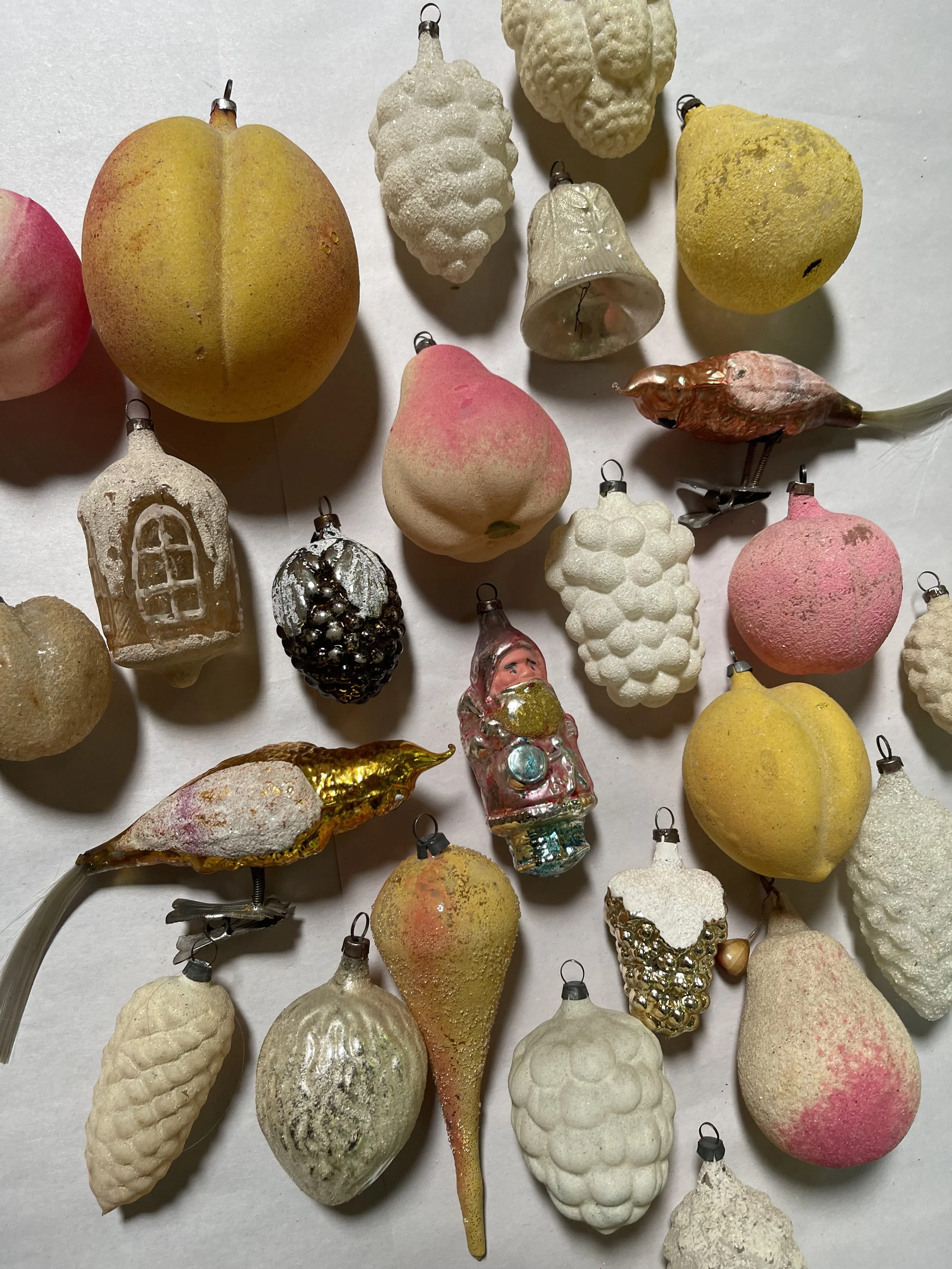
What is a crushed glass ornament?
On an antique crushed glass ornament, the body is usually thin blown glass. A granular glass decoration was then adhered to part or all of its exterior. Depending on the piece, the coating may resemble fine sugar, coarse frost, or small translucent crystals.
The finish is different from the smooth colored surface of a painted ornament. It is also different from silvering, which is placed inside the hollow glass to create a reflective appearance. A crushed glass ornament may be unsilvered beneath its coating, although construction varies and an individual piece should be examined on its own.
The coating was not merely a dusting of modern glitter. Real ground glass produces sharper, more irregular reflections and a noticeably dimensional surface. Clear particles can look icy over a colored base, while colored particles may help build the ornament's final color and shading.
Why these ornaments are associated with Germany
The Thuringian town of Lauscha became a major center of glass ornament production. The work was often divided among skilled glassblowers and home-based decorators: glass tubing was heated at the lamp, blown into bubbles or molds, and then passed through additional hands for silvering, painting, and finishing.
That history matters, but it should not become a shortcut for attribution. Germany had more than one ornament-producing workshop and region, and antique ornaments rarely carry the kind of permanent maker's mark collectors would like to find. A familiar finish or form can support an attribution; it does not prove one by itself.
For that reason, I prefer descriptions such as "believed to be German" or "German, based on construction and decoration" when the evidence is persuasive but not documented by an original box, label, or firm provenance.
Forms collectors may encounter
Crushed glass decoration can appear on several kinds of early German ornaments, but it is especially effective on naturalistic forms. Collectors may find it on:
• Pears, apples, grapes, strawberries, and other fruit
• Pinecones, nuts, mushrooms, and vegetables
• Round or shaped blown-glass ornaments
• Molded figurals with selectively frosted details
• Ornaments combining paint, clear glass particles, and other applied decoration
The coating may cover the entire form or only selected areas. A fruit ornament, for example, might have a dense sugary body with painted shading, a dark stem detail, or a contrasting leaf. On another piece, crushed glass may be used only as snow, trim, or an accent.
Not every rough or sparkling antique surface is crushed glass. Mica, often called glimmer in historical descriptions, tends to appear as thin reflective flakes rather than chunky, sugar-like grains. Fine sand, mineral particles, paint texture, and later craft glitter can also be mistaken for ground glass in online listings.
How to identify an antique German crushed glass ornament
No single clue confirms age or origin. The most convincing examples make sense as a whole: glass, form, finish, hardware, wear, and provenance agree with one another.
1. Look closely at the coating
True ground glass has irregular particles with crisp, glassy reflections. Under magnification, the surface should look granular rather than like a uniform plastic sparkle. Antique coatings are often uneven because they were applied by hand, but unevenness alone is not evidence of age.
Study areas where the decoration has worn away. The exposed surface may reveal clear or colored glass, paint, or an aged adhesive layer beneath the particles. Natural loss usually occurs on projecting areas and wherever the ornament has been handled or rubbed against storage material.
2. Examine the ornament beneath the sparkle
The base ornament matters as much as the coating. Antique German blown-glass ornaments are typically light for their size and may show subtle irregularities associated with hand production. Mold seams can be present on molded forms and are not automatically a sign of a modern reproduction.
Look at the neck or pike if it is visible. Its shape, thickness, and relationship to the body can offer more useful evidence than the cap alone. A modern hanger can be added to an old ornament, and an old-looking cap can be moved to a newer one.
3. Treat the cap as one part of the evidence
Caps can help with dating, but they are frequently missing, replaced, or reused. Early examples may have simple wire hangers or old metal caps, while uncapped fruit and figural ornaments are also common.
A cap stamped "Germany" can support an attribution, but it does not establish that every other component is original. Conversely, the absence of a marked cap does not disqualify an ornament. Inspect the neck for chips, adhesive, fresh scratches, or a cap that fits poorly.
4. Expect age, but do not confuse damage with authenticity
An antique coating may show scattered loss, softened color, darkened adhesive, or dust held between the particles. Those signs can be consistent with age. They are not a requirement, and heavy deterioration does not make an ornament more desirable.
More serious concerns include:
• Active shedding each time the ornament is moved
• Cracks extending from the neck or through the body
• Crushed or missing sections of the underlying glass
• Large areas of newly applied material
• Obvious modern glue over old decoration
• Repainting that obscures the original surface
The phrase "crushed glass" can create confusion in condition reports. It may describe the decorative coating, or it may mean that the hollow ornament itself has been broken or collapsed. When buying online, ask the seller to clarify which meaning is intended.
5. Ask for photographs that show texture and construction
Front-facing photographs often flatten a granular surface. Ask for close images taken in angled light, along with photographs of the back, neck, cap, and any bare areas. A view through an opening can help establish whether the body is clear, colored, or silvered glass.
An original box or documented family history can add valuable context, but neither should override the physical evidence. Ornaments and boxes are often reunited later, sometimes innocently.
Antique ornament or modern German glass glitter?
"German glass glitter" is still sold as a decorative material. It may be made from finely ground glass and, in some versions, coated with silver that develops a patina. Contemporary artists use it on newly made ornaments, holiday figures, cards, and other crafts.
This means real glass glitter is not proof that an object is antique. A modern piece can have genuine German glass particles, deliberate tarnish, and convincing vintage styling.
When evaluating a purported antique, look past the sparkle. Does the underlying ornament have period-appropriate construction? Does the wear occur naturally on exposed areas? Are the paint, cap, neck, and coating consistent with one another? Is there fresh adhesive pooled between older-looking particles? A convincing attribution comes from the combination of evidence, not from the material name in a listing.
What affects collectibility?
Rarity is only one part of the picture. Collectors also consider form, color, scale, surface quality, and how much of the original decoration remains. An unusual fruit or figural form with strong color and a stable, largely intact sugar coating will generally attract more interest than a common shape with extensive loss.
Condition should be described plainly. Scattered coating loss may be expected, but cracks in the glass body, a broken neck, repairs, or widespread replacement of the decoration materially change the ornament. When buying, compare the price with the exact condition of that example rather than with an apparently similar ornament photographed from a distance.
I would be cautious about assigning a firm date or value from photographs alone. Small construction details can change an attribution, and the market for specialized German ornaments depends heavily on form and condition.
How to care for crushed glass ornaments
The surface that makes these ornaments special is also what makes them difficult to clean. Water, liquid cleaners, polish, adhesive, and vigorous brushing can loosen the coating, disturb paint, or leave a permanent change in sheen. For broader preservation basics, see the care and storage guide.
For routine care:
• Handle the ornament over a padded surface
• Support the body rather than gripping the cap or neck
• Avoid rubbing, wiping, or testing the coating with a fingernail
• Do not wash or soak it
• Keep it away from moisture, temperature swings, and direct sunlight
• Wrap it loosely in clean, soft, acid-free tissue without pressing against the textured finish
• Place it in an individual compartment so it cannot scrape another ornament
If particles are already loose, repeated "testing" will only remove more of the original finish. Preserve what remains and keep any detached pieces with the ornament. Because genuine ground glass can have sharp edges, keep shedding examples away from children and pets and wash your hands after handling loose particles.
I do not recommend applying a modern sealant to stop shedding. A coating can darken the surface, alter its reflectivity, trap dirt, and make future conservation more difficult. For an important or unstable piece, consult a conservator experienced with painted or decorated glass.
A small finish with a large visual effect
Antique German crushed glass ornaments reward close looking. From across the room, the surface reads as frost. In the hand, it becomes a field of tiny glass particles layered over an equally fragile blown form.
Their appeal is not perfect condition or mirror-bright sparkle. It is the combination of handwork, texture, and survival. The best way to collect them is slowly: examine the whole ornament, ask careful questions, and leave room for uncertainty when the evidence does not support an exact maker or date.
That measured approach does not make these ornaments less interesting. It makes the details that can be known, and preserved, matter more.
You can browse current vintage Christmas ornaments in the shop, use the Tinsel Box ornament organizer app to document condition notes and provenance, or continue with the vintage glass Christmas ornaments guide.
Editorial note
The phrase "crushed glass ornament" is used inconsistently by sellers. This article uses it for ornaments intentionally decorated with ground glass. It does not use the phrase for a hollow ornament whose body has been crushed or broken.
About the author
Written by Leslie Brocksmith, founder of The Tinsel Box. Leslie curates vintage Christmas ornaments and shares collector-focused guidance on ornament care, identification, storage, and display.